
What is becoming clear—especially for smaller electric cooperatives—is that power density, not nameplate capacity, is the binding constraint. Most distribution substations were engineered to operate comfortably at 60–80% utilization, with 30-plus-year planning horizons, predictable load growth, and diversity assumptions that no longer hold.
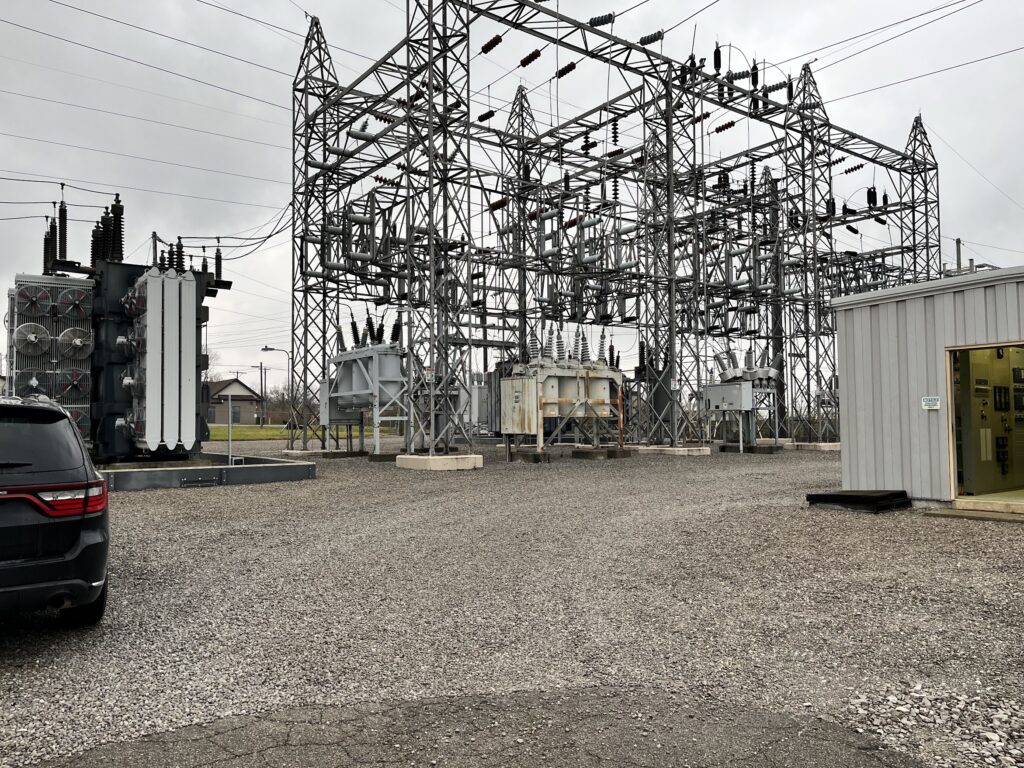
That model worked when growth was linear and dominated by residential, light commercial, and modest industrial demand. It does not map well to today’s reality.
Exponential Demand Meets Linear Infrastructure
AI, advanced compute, cybersecurity workloads, and data-center-driven services are evolving at an exponential pace—measured in months, not decades. Training runs, inference clusters, edge compute, and redundancy requirements compound rapidly. These loads are:
- Highly concentrated
- Continuous (24×7)
- Low diversity
- Sensitive to power quality and outage duration
This is fundamentally different from traditional rural load profiles.
During a recent discussion, a local cooperative candidly noted that it would be fortunate to support a single 3–5 MW data-center load without major upstream upgrades. That statement is not unusual—it is representative of many co-ops whose substations, feeders, and transmission interties were never designed for dense, single-customer megawatt blocks.
Why Hyperscalers Are Bypassing the Grid
This mismatch explains several macro trends now visible across North America:
- On-site generation and microgrids
Large data-center operators are increasingly building generation at the fence line—gas turbines, reciprocating engines, or dedicated renewables with storage—to avoid grid constraints and interconnection delays. - Direct procurement of firm power
Nuclear power purchase agreements, plant life extensions, and even reactor restarts are being pursued because dispatchable, high-density energy is scarce. - Compute following energy, not fiber
The historical assumption that compute follows network topology is being inverted. Compute is increasingly following where energy is abundant, scalable, and predictable.
SpaceX and the Orbital Compute Insight
The SpaceX strategy highlights this shift in a particularly stark way. By exploring compute in medium-earth orbit (MEO) and related architectures, SpaceX is implicitly acknowledging two facts:
- Solar energy is far more plentiful and continuous in space
- The marginal cost of additional generation in orbit scales differently than on land
This is not merely a satellite story—it is a power-density story. When terrestrial grids struggle to deliver incremental megawatts quickly, alternative energy domains become economically rational, even if they appear unconventional.
What This Means for Co-ops and Rural Utilities
For smaller cooperatives, the issue is not a lack of competence or planning discipline—it is that the planning assumptions themselves have shifted. Infrastructure built for gradual growth is being asked to absorb step-function demand.
Key implications:
- Traditional 10- and 20-year load forecasts understate risk
- Substation “headroom” evaporates quickly with a single large compute customer
- Transmission constraints, not generation, often become the first bottleneck
- Interconnection timelines can exceed the business timelines of modern compute projects
The Strategic Question Ahead
The real question is not whether AI, data centers, and edge compute will continue to grow—they will. The question is where that growth can physically land.
Regions that can offer:
- High-density power,
- Fast interconnection,
- Predictable regulatory pathways, and
- Integrated generation strategies
will attract investment.
Those that cannot will see compute, capital, and innovation route around them—sometimes literally into orbit.
This is the structural tension now shaping North American power planning, and it is why power density has quietly become one of the most important variables in the energy-technology landscape.